
India’s small and medium business sector is undergoing a rapid AI-driven transformation, according to the sixth edition of Salesforce’s Small and Medium Business Trends Report, released this week.
The survey of over 200 Indian SMBs reveals striking results: 95% report more efficient operations, while 97% have seen measurable gains in productivity, revenue, or customer experience.
These findings carry significant weight for a sector that employs over 25 crore people and contributes 45% of India’s exports, signaling AI has shifted from enterprise luxury to operational necessity for smaller firms navigating today’s digital marketplace.
The Execution Gap Driving Adoption
Despite strong customer demand, most Indian SMBs continue to operate with lean teams, limited budgets, and fragmented technology stacks.
The Salesforce report found that the average small business uses seven different applications, with more than half reporting data inconsistencies across tools.
A typical operation might rely on WhatsApp for customer communication, Excel for order tracking, and manual phone calls for follow-ups. This patchwork approach creates data silos and limits scalability.
This fragmentation creates what the report describes as an “execution gap”: the distance between what customers expect and what stretched teams can deliver.
As labour costs rise and qualified talent becomes harder to find, simply hiring more staff is no longer a viable growth strategy for many firms.
Real Results from Real Businesses
Several Indian companies highlighted in the report illustrate how AI-powered platforms are producing tangible outcomes. Hubilo, a virtual events platform, consolidated its fragmented sales systems onto Salesforce and deployed AI-driven automation.
The result was a ninefold improvement in quote generation speed, with sales representatives saving hours through automated data capture.
TASC Group deployed two autonomous AI agents for lead sourcing and outreach, generating over 2,000 actionable leads and a sixfold increase in email response rates.
In customer service, the regional streaming platform aha centralised its support operations and now resolves roughly 60 percent of incoming queries autonomously through chatbots, handling over 5,000 daily queries with average resolution times between 2.5 and 5 minutes.
Jaipur Rugs, a hand-woven rug maker expanding into direct-to-consumer retail, integrated its previously scattered data systems and saw a 30 percent increase in lead-to-order conversion, a 40 percent improvement in customer satisfaction, and faster order processing across all channels.
Industry Voices
Richard Jackson, Chief Transformation Officer at TASC Group, said the shift has been fundamental to scaling.
By embedding real-time insights and automation into our core processes, we are building a future-ready organization that can scale quickly while delivering exceptional value to clients, he explained.
Yogesh Chaudhary, Director of Sales at Jaipur Rugs, echoed the sentiment:
Queries are answered quicker, order processing is smoother, and shipping timelines have reduced.
What This Means for Small Businesses
The data paints a clear picture of divergence. The report found that 88 percent of growing SMBs are investing more in technology than a year ago, compared with just 46 percent of declining businesses.
Growing firms also prioritise customer experience over new customer acquisition, suggesting that retention and service quality increasingly differentiate winners from laggards.
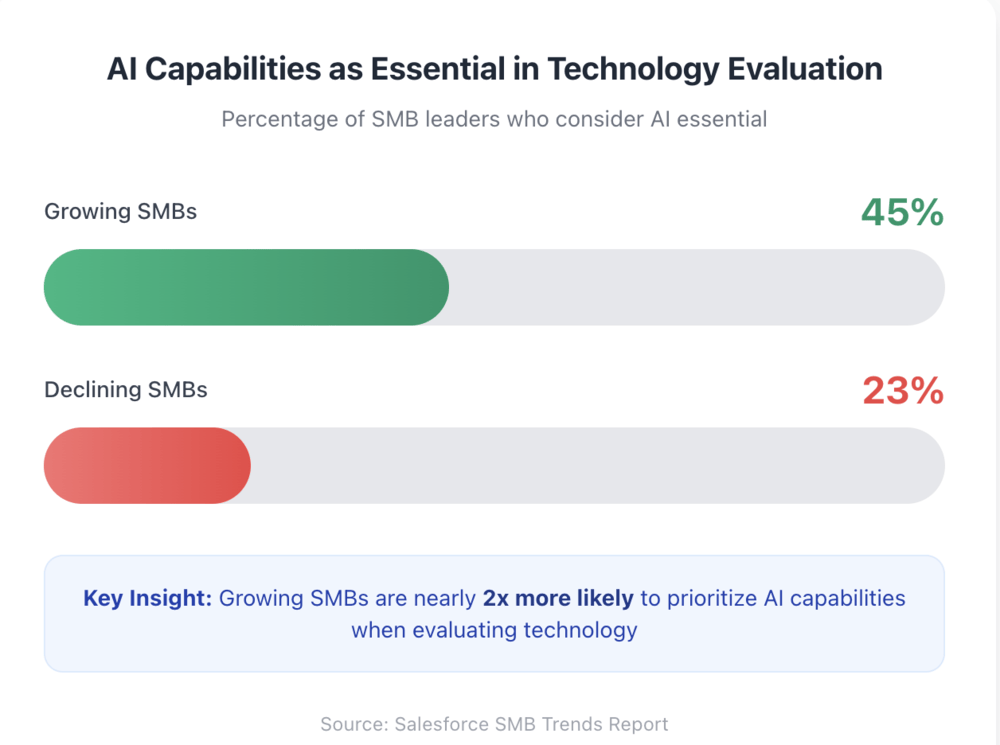
Among growing SMB leaders, 45 percent said AI capabilities are essential when evaluating technology, compared with only 23 percent at declining businesses.
The practical implication is straightforward. A Mumbai-based firm that once needed three customer service representatives can now handle the same volume with one human agent and AI managing routine queries.
Marketing teams that previously outsourced content creation to agencies are generating campaign copy, social posts, and multilingual content in-house, in minutes rather than weeks.
A Word of Caution
Not all observers are convinced the transition will be seamless. The report itself acknowledges that AI deployment without proper data foundations often fails.
If customer information lives in scattered WhatsApp chats, order details in spreadsheets, and product knowledge only in the founder’s head, AI tools have little to work with.
Eighty-six percent of surveyed leaders said improving data quality would increase revenue, and 47 percent admitted feeling overwhelmed by too many business tools.
Adoption driven by fear of missing out, without thoughtful planning and governance, rarely pays off.
Looking Ahead
With 79 percent of Indian SMBs already investing in AI in some form and over a third fully implementing it, the competitive dynamics are shifting fast. Businesses that move early on unified data platforms and agentic AI tools stand to widen the gap against slower-moving peers.
For the millions of small firms powering India’s export economy and domestic growth, the question is no longer whether to adopt AI, but how quickly they can do so before the execution gap becomes a permanent disadvantage.
You May Also Like: